Why Sitting Down Is Shutting Down Your Creativity — Discover the Whiteboard Effect
Updated: 4 days ago

You’ve been at your desk for two hours. The cursor blinks. The screen stares back. You know what you want to say — or at least you did when you sat down — but somehow the ideas that felt so alive in the shower this morning have gone flat. So you check your email. Make a coffee. Scroll through something you won’t remember. Then you sit back down and try again.
Sound familiar?
Here’s what nobody told you: the problem isn’t your brain. It’s your chair.
The Creative Postures Hiding in Plain Sight
Think about the most creative people in history and picture how they worked. Hemingway wrote standing at a makeshift desk he’d fashioned from a bookcase. Dickens stood at his writing desk to create Oliver Twist and A Christmas Carol. Virginia Woolf worked at a desk so high she had to stand to reach it. Churchill — who won a Nobel Prize for Literature on top of everything else — wrote standing up, cigar in hand. Kierkegaard, Nabokov, Lewis Carroll, Thomas Jefferson, Leonardo da Vinci — all standing.
Now widen the lens. Painters stand at easels. Sculptors stand before marble and clay. Chefs create on their feet, moving between surfaces. Conductors stand before orchestras, shaping sound through gesture and movement.
What do all these people have in common? They don’t do their most important creative work sitting down.
An important distinction, though. Not all standing work is creative work. A surgeon stands for hours in the theatre, but that’s precision execution — the creative thinking happened earlier, when the procedure was planned, contingencies mapped out, and solutions prepared for every eventuality. The same applies to assembly line workers, guards, and countless other roles where standing is about access or endurance, not imagination. What we’re interested in here is something more specific: what happens when the body is upright, gently moving, and the mind is free to generate rather than execute.
And yet most of us spend our working lives doing exactly the opposite — seated, hunched forward, eyes locked on a glowing rectangle, our entire creative capacity reduced to micro-movements of our fingers on a keyboard. We’ve essentially switched off the body from the neck down and asked the brain to perform solo.
No wonder the cursor blinks back at us.
Your Brain Has a Creative Mode — and Sitting Suppresses It
Neuroscience has identified something called the Default Mode Network, or DMN. It’s a system of interconnected brain regions that becomes most active when you’re not concentrating hard on a specific task. When you’re in the shower, walking through the park, or letting your mind drift — that’s the DMN at work, quietly making connections between ideas, drawing on memories, generating the kind of associative, lateral thinking that produces your best insights.
The DMN is, in essence, your brain’s creative engine. And it runs best when your conscious, executive mind steps back.
A word of caution, though. This same network has a darker talent. Leave it running with no direction — no problem to solve, no idea to explore — and it doesn’t sit quietly. It tells stories. Specifically, it tells stories about what might go wrong. That 3 am worry spiral? That’s the DMN with nothing constructive to do, defaulting to its other speciality: rumination and catastrophic thinking. Same engine, different fuel.
The key is direction. Give the DMN a seed — a question, a half-formed idea, a creative challenge — and then step back and let it work. That’s when the magic happens. It’s the difference between staring at the ceiling, worrying about tomorrow’s meeting, and stepping up to a whiteboard with the words “What if we…” at the top.
Here’s the other problem: sitting at a desk, staring at a screen, and trying to force ideas engages exactly the wrong system. It activates your brain’s executive control network — the analytical, focused, logical machinery. That’s useful for editing a spreadsheet or following a procedure, but it actively suppresses the DMN. You’re essentially revving the engine with the handbrake on.
When you stand up, move around, or engage your body in something rhythmic and undemanding — walking, drawing on a whiteboard, even washing up — the executive system relaxes its grip. The DMN comes alive. Ideas flow.
This is why your best thinking happens in the shower. It’s not magic. It’s your brain finally being allowed to do what it does best, because your body is gently occupied and your conscious mind has stepped aside.
The Whiteboard Effect
I call this the Whiteboard Effect, and it’s a pattern so consistent it deserves a name.
Stand at a whiteboard with a marker in your hand, and something remarkable happens. Your body is upright and engaged. Your arm is moving in broad, sweeping gestures — not the cramped micro-movements of typing, but expansive physical expression. The medium is forgiving: you can write, draw, erase, and reorganise. There’s almost no friction between thought and expression.
What’s happening beneath the surface is a convergence of three powerful neurological forces:
First, embodied cognition. Your body isn’t just carrying your brain around — it’s actively shaping how you think. Research from Stanford found that walking increases creative output by up to 60% compared with sitting. Standing alone improves divergent thinking. And broad physical movements — the kind you make when writing on a vertical surface — activate neural pathways that sitting simply cannot reach. When you stand and move, you think differently. Literally.
Second, the Default Mode Network is freed. The low cognitive load of whiteboarding — no toolbars, no formatting menus, no file management — means your executive control system isn’t monopolised by the mechanics of the task. There’s just you, a surface, and your thoughts. The DMN can run freely in the background, making the associative leaps that produce insight and originality, as long as you seed it correctly.
Third, reduced cognitive load feeds creativity. Digital tools demand an enormous amount of mental overhead just to operate them. Finding the right button, navigating menus, managing windows — all of this eats into the cognitive resources that could be serving your ideas. A whiteboard strips all of that away. The gap between having a thought and expressing it becomes almost nothing.
The shower, the park walks, the whiteboard — they’re all the same phenomenon. Your body is gently engaged, your executive mind relaxes, and your creative engine is finally allowed to run.
What This Means When You Stand Up to Speak
Now consider what happens when you step onto a stage, stand at the front of a meeting room, or rise to give a presentation.
Your body is upright. You’re physically present in a way that sitting never achieves. You’re moving — gesturing, shifting your weight, perhaps walking the stage. Your voice is engaged, your breathing deepens, and your whole body becomes part of the communication.
In other words, the Whiteboard Effect is already working in your favour. Your body-mind system is primed for exactly the kind of creative, connected, fluid thinking that makes a great speaker.
But there’s a catch. And this is where it gets interesting.
For many people, the moment they stand up in front of others, something else kicks in: fear. Not real, physical danger — nobody ever died from giving a presentation — but projected fear. The mind races ahead and constructs a catastrophe: What if I forget my words? What if they think I’m foolish? What if I fail?
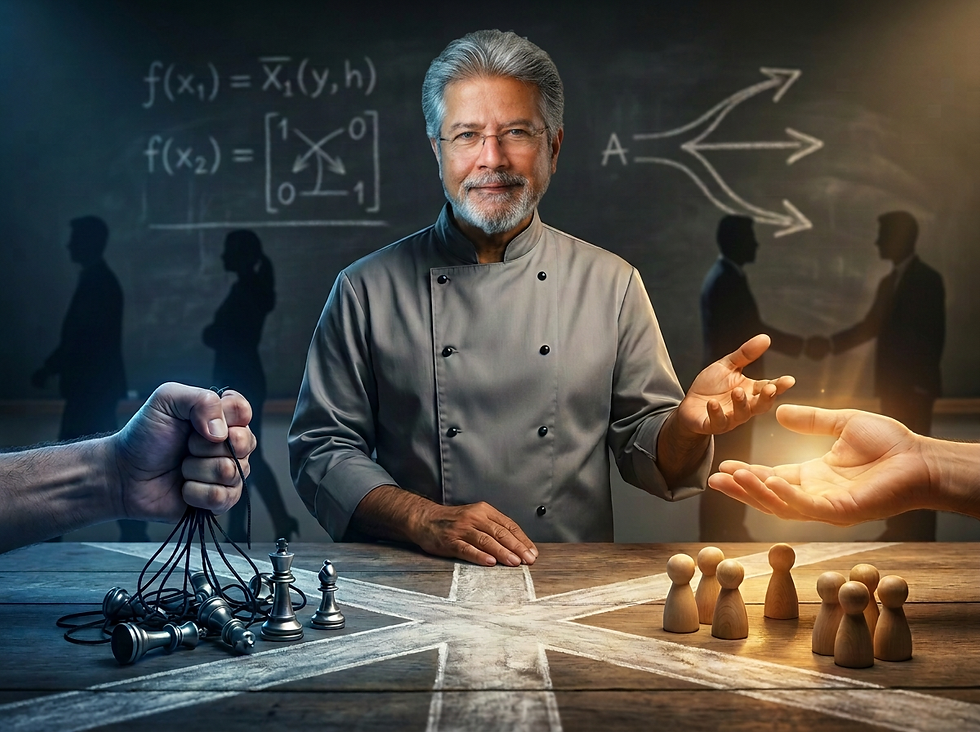
Each of those fears rests on a chain of imagined variables — a sequence of things that would all need to go wrong, in exactly the right order, for the catastrophe to materialise. And the truth is, they almost never do. But the body doesn’t know the difference between a real threat and a vividly imagined one. The amygdala fires. Cortisol floods the system. The executive control network seizes the reins.
And just like that, the creative engine shuts down. The DMN goes quiet. The very system that was about to make you brilliant gets overridden by a fear response designed for sabre-toothed tigers, not sales presentations.
This is why nervous speakers go blank, become robotic, and lose the thread of their thoughts. It’s not that they lack ability. It’s that fear that has hijacked the system that was already set up to help them succeed.
The Antidote: Curiosity
For years, the standard advice for nervous speakers was to imagine the audience naked. It sounds absurd, but there was an instinct behind it — the idea was to disrupt the fear response by replacing the threatening image with something ridiculous. The problem is, it doesn’t really work. You’re still thinking about the audience as something to be managed, and your amygdala isn’t fooled that easily.
But there’s something that does work, and neuroscience tells us why: Curiosity.
Curiosity and fear cannot easily coexist in the brain. They compete for the same neural real estate. When you become genuinely curious, you activate the brain’s dopamine-driven reward circuits. Dopamine doesn’t just make you feel good; it sharpens attention, enhances learning, and opens up exactly the kind of associative thinking that the DMN thrives on.
But here’s the subtlety: curiosity has to be framed carefully. If you ask yourself, “I wonder how my idea will land,” you’ve left the door ajar. Your DMN — the same mischievous storyteller we met earlier — may helpfully supply answers like “It might bomb” or “They’ve heard this before.” And just like that, you’re back in fear land.
The trick is to frame your curiosity so it can only travel forward. Ask yourself questions that have no negative answer. Smile as you walk into the room and tell yourself, “This is going to be fun. I can’t wait to show them this.” Or: “I wonder which part they’ll find most surprising.” Or simply: “Who’s going to be the first person to nod?”
These aren’t affirmations. They’re directions. You’re giving the DMN a positive lead to follow — a seed of anticipation rather than anxiety — and once it has that lead, it does what it does best: it builds on it. Dopamine flows. Your body relaxes into the standing, moving, expressive state it was already primed for. The Whiteboard Effect kicks in.
This is the real secret of great speakers. They’re not fearless. They’re curious — and they’ve learned to point that curiosity somewhere fear can’t follow.
Step Away From the Desk. Stand Up. Let Your Body Think.
The Whiteboard Effect isn’t a productivity hack. It’s a recognition of something fundamental about how we’re built: your body and your brain are not separate systems. They are one integrated system, and when you engage them together — standing, moving, expressing — your capacity for creative thought expands dramatically.
So the next time you’re stuck, try this: don’t sit there and grind harder. Stand up. Walk to a whiteboard, a window, or simply around the room. Let your body re-enter the conversation.
And if you’re dreading a presentation, know this: the moment you stand up and begin to move, your body is already doing the work. The Whiteboard Effect is on your side. Your only job is to not let fear in through the side door.
The ideas are there. They always were. You just need to stand up to find them.

Comments