Game Theory: Why Generosity and Cooperation Always Win
Updated: 4 days ago
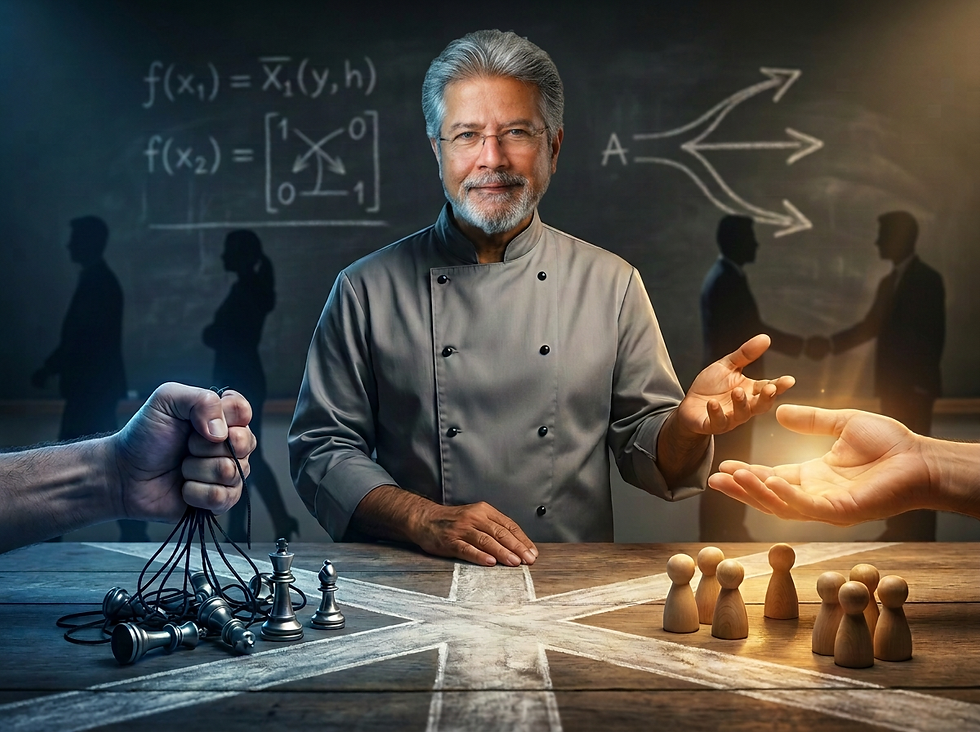
What the Prisoner’s Dilemma reveals about fear, generosity, and the long game of life.
In 1950, two researchers at the RAND Corporation — a think tank funded by the United States military — were trying to solve a problem that could have ended the world. The Cold War was escalating. Both America and the Soviet Union had nuclear weapons. And the question haunting every strategist in Washington was deceptively simple: if both sides would be better off cooperating, why can't they stop threatening to annihilate each other?
The problem that captured the attention of the RAND researchers was soon given a name: the Prisoner's Dilemma. Its origins are simple and compelling, rooted in a scenario where two individuals find themselves in trouble. This situation quickly became a cornerstone of game theory, the mathematical discipline concerned with analysing how people make decisions when their choices are influenced by the actions of others.
Game theory didn't just reshape military strategy. It revealed something profound about human nature — something that plays out not only between superpowers but also between business partners, between friends at a crossroads, and within the mind of anyone who has ever faced a difficult decision and felt the pull toward self-protection.
Two Prisoners, One Impossible Choice
Two suspects are arrested after a crime. The police separate them into different rooms. Each prisoner is offered the same deal: betray your partner and testify against them, or stay silent.
If both stay silent — if they cooperate with each other — the police can only charge them with a minor offence. A light sentence each. If one betrays while the other stays silent, the betrayer walks free, and the silent one gets the maximum sentence. If both betray, both get a heavy sentence — not the worst possible outcome for either, but far worse than if they'd simply kept their mouths shut.
Put yourself in the detective's chair for a moment and watch what happens. Each prisoner, sitting alone, runs the same calculation. "If my partner stays silent, I'm better off betraying — I walk free. If my partner betrays me, I'm definitely better off betraying — at least I won't get the maximum sentence." Whatever the other person does, betrayal looks like the smart move.
So both betray. And both end up with heavy sentences. Two people, each making the individually "rational" choice, produce a collectively terrible result.
This is what fascinated the RAND researchers. It wasn't a problem of stupidity. It was a problem of fear meeting logic. Both prisoners reason correctly. Both act in what appears to be their self-interest. And both lose.
The Cold War played out exactly this way for decades. Both superpowers knew that cooperation — disarmament, diplomacy — would leave them both safer. But neither could risk being the one to cooperate while the other didn't. So they spent trillions on weapons neither side wanted to use, locked into a pattern that served no one, driven by the fear of what the other side might do.
———
The Arms Race You Can See Everywhere
Once you understand the structure of the Prisoner's Dilemma, you start noticing it in places far removed from interrogation rooms and nuclear silos.
Two competing airlines on the same route keep slashing prices. Each one reasons: "If we don't cut fares, they will, and we'll lose customers." So both cut. And both end up flying full planes at a loss, trapped in a price war that's destroying them both. The "rational" move for each airline is the ruinous move for the industry.
Two pharmaceutical companies are racing to develop similar drugs. Each pours hundreds of millions into being first to market. If they'd collaborated — shared research, split the cost, divided the market — both would have been more profitable. But neither can risk letting the other get there first. So both overspend, and the shareholders of both companies pay the price.
Even in nature, the pattern appears. Male peacocks grow increasingly extravagant tails — not because enormous tails are useful (they're a liability; they attract predators and make it harder to fly) — but because each peacock that grows a slightly larger tail gets a slight mating advantage over its rivals. The result, over generations, is tails so absurdly large that they endanger the species. Biologists call this a costly signalling arms race, and it's the Prisoner's Dilemma playing out across evolutionary time.
In each case, the structure is identical. Both parties would benefit from cooperation. But the fear of being exploited — of being the one who cooperates while the other doesn't — drives both toward a worse outcome.
Now, these are all stories about organisations and animals, about strategy at scale. Most of us aren't running airlines or growing tail feathers. But I'm telling you these stories for a reason: I want you to see the pattern clearly before I show you where it lives closer to home. Because the Prisoner's Dilemma isn't just a problem for superpowers and corporations. It shows up at very specific moments in ordinary life. And it's at those moments that everything I'm about to tell you matters most.
———
A Tournament That Changed Everything
Before I bring this closer to home, let me tell you about an experiment that offers a way out of the trap.
In 1980, a political scientist named Robert Axelrod did something unusual. He invited game theorists, mathematicians, and computer scientists from around the world to submit strategies for a simple computer tournament. The rules were straightforward: each program would play the Prisoner's Dilemma against every other program, over and over again, for two hundred rounds. The strategy that accumulated the most points across all its interactions would win.
The entries were extraordinary. Some were fiendishly complex — programmes designed to detect patterns in opponents, exploit weaknesses, switch between cooperation and aggression based on elaborate internal calculations. Some were deliberately nasty, designed to punish and dominate. Some tried to be unpredictable, randomising their choices to prevent opponents from gaining any advantage.
The winner was none of these.
The winning strategy was submitted by Anatol Rapoport, a mathematical psychologist. It was called Tit-for-Tat, and it was the simplest programme in the entire tournament. It did exactly two things: it cooperated on the first move, and then it simply copied whatever the other player had done in the previous round. That was it. Four lines of code.
It had no ability to detect patterns. No elaborate internal model. No cunning. It couldn't even "win" a single individual game against an aggressive opponent — the best it could do was draw. And yet, across the entire tournament, it accumulated more points than every sophisticated, calculating, aggressive strategy that had been designed to beat it.
Axelrod was so surprised that he ran the tournament again, this time with even more entries from people who had studied the results of the first. Tit-for-Tat won again.
When Axelrod analysed why, he found four qualities that characterised the winning approach. It was nice — it never betrayed first. It was retaliatory — if you betrayed it, it responded immediately. It was forgiving — the moment you returned to cooperation, so did it. And it was clear — there was no ambiguity about what it was doing or why.
What's remarkable is what didn't win. A strategy called FRIEDMAN, which cooperated until betrayed and then retaliated forever, performed poorly because it could never recover a relationship. Strategies that tried to be clever, probing with occasional betrayals to test the water, triggered chains of mutual retaliation and got dragged into spirals they couldn't escape. Strategies that were purely random confused everyone, including themselves, and were trusted by no one.
The implications are extraordinary, and they go far beyond a computer tournament. What Axelrod demonstrated, mathematically, was that over time, generosity and cooperation don't just feel good — they win. The aggressive strategies, the cunning ones, the ones designed to exploit and outmanoeuvre? They burned through their relationships, triggered retaliation everywhere they went, and collapsed under the weight of the hostility they'd generated. Meanwhile, the generous strategies found one another, created mutual benefit, and pulled away from the field.
Robert Trivers, an evolutionary biologist and later Martin Nowak, a mathematical biologist, showed that this isn't just a mathematical curiosity — it's how cooperation evolves in nature. Together, their work has helped demonstrate that organisms that cooperate and forgive outcompete those that don't, provided interactions are repeated, as reputations matter. Five mechanisms drive the evolution of cooperation in biological systems, and two of them — direct reciprocity and indirect reciprocity, which is essentially reputation — are mathematical proofs that being trustworthy and generous is a winning long-term strategy. Not a moral aspiration. A survival advantage.
The most sophisticated selfish strategies were beaten by the simplest generous one. And this isn't just true in computer simulations — it's how life itself evolved.
———
When the Game Comes Home
So far, I've been telling you about superpowers, airlines, peacocks, and computer programmes. Interesting, perhaps. But distant.
Now let me bring this to the place where it actually matters — the moments in your own life when you find yourself at a crossroads.
Because here's the thing: most of the time, you're not calculating. You're not sitting in your kitchen running game theory on your spouse, or strategising against your colleagues over coffee. Ordinary life isn't a chess match, and most people aren't playing one. You're just living — cooperating naturally, being decent, getting on with things.
But then something happens. A betrayal. A redundancy. A diagnosis. A conflict you didn't see coming. A moment where the stakes suddenly feel very high and the ground shifts beneath you. And in that moment — at that crossroads — something changes in the way you think. The walls go up. The calculations begin. You find yourself, perhaps for the first time in months, thinking: What's their angle? What are they going to do? How do I protect myself?
That's the moment you've entered the Prisoner's Dilemma without knowing it. And the fear-driven logic of the dilemma is the same whether you're a Cold War strategist or a person who's just discovered their business partner has been talking to a lawyer.
Two partners in a relationship, each withholding vulnerability after a breach of trust because they're afraid of being hurt again, creating the very emotional distance they both dread. Two colleagues, after a restructuring, each protecting their territory, destroying the collaboration that would have elevated them both. A person facing a health scare, gripping for control, demanding certainty from doctors, generating exactly the stress and rigidity that makes everything harder.
At these crossroads, fear does something very specific to the brain, and this is where neuroscience meets mathematics.
———
The Lie Your Fear Is Telling You
Here's what happens neurologically when you hit one of those crossroads. Your amygdala fires. Your threat system activates. Cortisol floods your bloodstream. And your prefrontal cortex — the part of your brain that handles long-term planning, perspective-taking, and strategic patience — goes quiet. You lose the ability to see the future. And suddenly, the game you're in looks very, very short.
Game theorists have a term for the thing that fear destroys. They call it the shadow of the future — the extent to which you expect to interact with someone again. The longer the shadow, the more cooperation becomes the dominant strategy. When you expect a long future with someone, generosity, reliability, and forgiveness aren't naive. They're mathematically optimal.
What fear does is shorten that shadow. It makes the future disappear.
I've seen this in clinical settings and I see it constantly in coaching. A client sits across from me, consumed by anxiety about a conversation with their business partner, or a presentation to their board, or a conflict with their spouse. And the language they use is always the same: "This is make or break." "Everything rides on this." "If I get this wrong, it's over."
It's never true. But it feels true, because their nervous system has narrowed their field of vision to this single moment. The cortisol is flowing, the heart rate is up, and the prefrontal cortex — the part that would normally say "you've had forty difficult conversations with this person and you'll have forty more" — has gone offline. They've become the prisoner in the room, convinced this is the only game they'll ever play.
And in that contracted state, the "rational" choice is always to protect, defend, grip tighter. Fear creates the very selfishness that game theory proves to be suboptimal.
The Prisoner's Dilemma doesn't prove that betrayal is rational. It proves that fear makes you see the wrong game. You think you're trapped in a single encounter with no future, a finite game. In reality, life is an iterated game — the longest one you'll ever play — and the strategies that win iterated games are cooperation, generosity, clarity, and forgiveness.
———
There Is No Such Thing as a Finite Game
In 1986, the philosopher James Carse drew a distinction between two types of games. Finite games are played to win — they have fixed rules, a clear ending, and they produce winners and losers. Infinite games are played to keep playing — the rules evolve, players come and go, and the objective is continuation, not victory.
It's an elegant framework, and many writers have used it to distinguish between, say, a football match (finite) and a marriage (infinite). But I want to push further than Carse did, because I think the distinction is even more radical than he suggested.
I don't believe any game is truly finite.
Think about the football match. Yes, the whistle blows, and the score is settled. But the players will play another game. The manager's reputation carries forward. The way the team handled defeat — or victory — shapes their culture for years. The "finite" game is actually one move in a much longer sequence. The same is true of a job interview. You didn't get the role — game over? Not remotely. The interviewer remembers you. The industry is smaller than you think. The way you conducted yourself in that room follows you. I've seen people offered roles two years after an interview they thought they'd failed, because someone remembered their character.
When you truly absorb this — that there is no final whistle, that you will always play again — something remarkable happens to the weight you carry. The desperation drains out. You stop sacrificing your values to "win" a game that was never going to be the last one. You stop treating every setback as an ending. You can afford to be generous, because generosity in an ongoing game isn't a sacrifice — it's an investment in the next chapter, and the one after that.
This is what thoughtful detachment from immediate outcomes actually looks like. Not indifference but the recognition that no single result has the power to end you. You will play again tomorrow.
———
Beyond the Mathematics: The Position That Game Theory Can't Reach
Everything I've told you so far is well-established science. Axelrod's tournaments have been replicated. The evolutionary biology confirms it. Cooperation wins over time. But I want to take you somewhere the textbooks don't go.
Standard game theory, even at its most enlightened, is still externally referenced. Tit-for-Tat cooperates because cooperation produces better outcomes given what the other player does. It's still modelling the opponent, still calculating. It's a lighter grip than the aggressive strategies, but it's still a grip.
Here's what I've come to believe, through years of experience and, frankly, through making every mistake I'm about to warn you against.
Stop modelling the other person. Stop trying to predict their strategy, game out scenarios, or stay one step ahead. Instead, ask one question: Who do I want to be in this interaction?
Cooperate and be generous — not because it's the optimal counter-strategy, but because it keeps you in alignment with your own values. The win isn't in this game. The win is that you walk out of the room as someone you recognise.
Think about how much mental energy goes into modelling other people. The scenario-spinning, the "what if they..." thinking, the attempt to predict and outmanoeuvre. All of that is directed outward, at things you cannot control, and it is the source of most of the mental weight people carry. If your decision-making is internally referenced — based on your values rather than your prediction of someone else's behaviour — you've just removed an enormous burden. The decision becomes simple. Not easy, but simple. You know who you are. You act accordingly. And then you let go.
And here's the second, deeper claim: even if the other person betrays you and you never see them again, you haven't lost. Because you continue. The game with that particular person may be over, but who you were in that game shapes who you are in every game that follows.
Each act of betrayal reinforces the neural pathways of fear. This is neuroplasticity working against you — betray enough times, and your brain begins to assume betrayal is the norm. You become more suspicious, more defensive, and more exhausting to be around. And people respond to that, because human beings are exquisitely attuned to trustworthiness.
Conversely, the person who cooperated — who accepted a cost to maintain their integrity — has reinforced the neural pathways of trust and generosity. That capacity pays compound interest across every future interaction in ways that cannot be calculated at the time.
I think of it as an internal compass. Every decision either calibrates that compass or distorts it. Act out of fear often enough, and you no longer know which direction you're facing. Keep playing from your values, even when it costs you, and the compass stays true. That clarity — that integrity, in the literal sense of being integrated — is worth more than any individual game.
———
The Curious Paradox of Letting Go
There's a paradox buried in all of this, and it's the one I most want to leave you with.
Game theory proves that cooperation and generosity are optimal strategies. But the moment you cooperate because it's the optimal strategy, you've reintroduced the very calculating mindset that creates mental weight. You're still gripping — just more cleverly.
The real transformation happens when you stop optimising altogether. When you cooperate because it's who you are. When you let go of the outcome, not because "letting go produces better outcomes" (though it does), but because holding on was never yours to do in the first place.
This is what thoughtful detachment looks like. Not indifference. Not apathy. The recognition that you control your choices and your character, but not the rest. Rather than seeing it as a loss, you see it as a liberation. You were never supposed to carry the weight of controlling the outcome. That was a job you assigned yourself, and you can put it down.
So, the next time you're at a crossroads — a negotiation, a difficult conversation, a moment of conflict — notice where your mind goes. If it goes to "What will they do? How do I protect myself?" — recognise that as your threat system collapsing an infinite game into a single shot. Then ask a different question: What would the person I want to be do in this situation? Act on that. And let go of the result.
Over time, this changes more than your decisions. It changes your default state. Every time you play from your centre rather than from your fear, you strengthen a neural pathway. You train your brain to default to the long view. And the results, across the full arc of a life, take care of themselves — not because the universe rewards goodness, but because people are drawn to trustworthiness, clarity is magnetic, and compound interest works on character just as reliably as it works on money.
One person walks out of the room exhausted by their own strategising. The other walks out free.
The mathematics says the free one wins more. But by the time you've understood why, you've stopped counting.
And that, perhaps, is the final move — the one the game theorists never modelled. The move where you step outside the game entirely, not to avoid it, but to play it on your own terms, from your own values, with your hands open and your grip light.
That's how you win more. By no longer needing to.


Comments