Introducing The Existential Chef
Updated: Oct 19

Welcome to The Existential Chef: a way of looking at life, and at the mind that experiences it.
People sometimes ask about the name. Why a chef? Because a chef does exactly what this work is about.
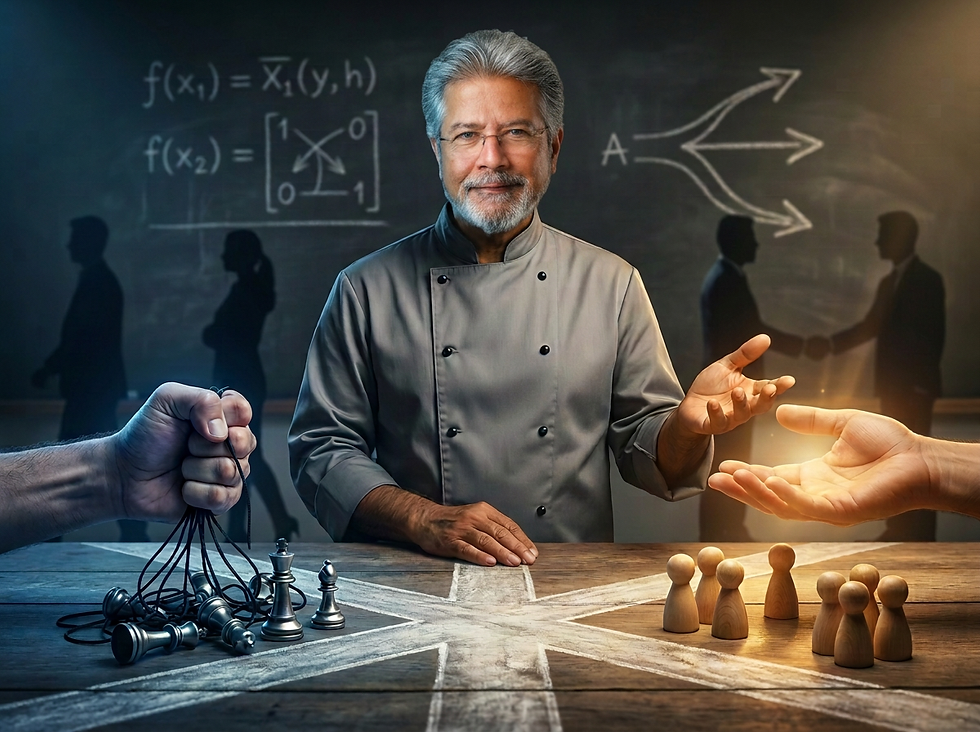
A chef doesn’t control the ingredients. The season decides what is available, the soil decides how it tastes, and some mornings what arrives at the kitchen door is bruised, misshapen, or not what was ordered. The chef works with what is there.
Life is the same. You don’t choose most of what arrives. You don’t choose the family you are born into, the times you live in, the setbacks that come without warning, or the relationship that ends before you expected. You don’t control the ingredients. But you do choose what you make with them.
A good chef understands contrast: that bitterness and sweetness need each other, that something sharp can cut through something heavy. A good chef understands timing: when to act quickly, when to let something rest, and — just as importantly — when to stop adding. That is not a bad description of the inner work either.
The existential part is simpler than it sounds. It means taking the questions that matter most seriously. Not philosophical abstractions, but real, lived questions. What kind of life am I actually building? Whose recipe am I following? Am I making something that nourishes me, or copying a dish someone else told me I should want?
The idea at the heart of it all
Everything here grows from one observation: most people are not suffering from the problems in their lives. They are suffering from their mind’s interpretation of those problems.
The facts of a situation are usually manageable. What makes a day heavy is everything the mind adds on top: the replayed conversation, the rehearsed disaster, the old rule about who you should be, the story about what someone else must be thinking. I call this mental weight. It is the accumulation of overthinking, second-guessing, worrying about futures that rarely arrive, and carrying expectations you never chose.
Mental weight comes from five main sources:
The verdicts the mind carries about who you are — I’m not enough, I always get it wrong.
The stories it writes about other people — what their silence means, what they must think of you.
The rules it still obeys — always be productive, never make a fuss, don’t disappoint anyone.
The past it hasn’t finished with — old hurts that reach into the present and colour new moments.
The futures it invents — the 3 a.m. rehearsals of things that haven’t happened and probably never will.
Underneath all five is the same thing: fear. Not the dramatic kind, but the quiet, constant hum of what if. Most of this fear is not a signal about real danger. It is a projection, a future built by the mind from uncertain pieces and presented as if it were certain.
The mind behind the weight
It helps to know a little about how the mind works, because understanding the machinery changes your relationship with it.
Your brain runs on at least three networks. The Story Brain narrates your life, replays the past, and imagines the future. It is the source of most of your creativity and most of your mental weight. The Alarm Brain decides what is urgent, and when it is on edge it treats everything as a threat. The Action Brain plans, decides, and acts, often carrying out what the other two have already set in motion.
When these networks are in harmony, life feels steady. When the Story Brain spins, the Alarm Brain sounds, and the Action Brain rushes to respond, life feels heavy. Much of the work here is learning to notice which one is speaking — and to give the Story Brain better material, through what I call your thought diet: everything you read, watch, scroll, hear, and dwell on.
A compass, not a recipe book
To help set the weight down, I use a compass with four points: Authenticity, Resonance, Insight, and Awareness — ARIA.
Authenticity asks: What do I actually value here, stripped of what others might think?
Resonance asks: Am I responding to what is happening now, or reacting to something from before?
Insight asks: What do I actually know, and what is my mind adding?
Awareness asks: Am I noticing my thoughts, or am I lost inside them?
These are not steps to follow in order. They are four ways of looking at the same moment. Often one question is enough. Each one turns the mind from fear towards curiosity — and fear and curiosity cannot fully occupy the mind at the same time.
Some of the ingredients
Over the years, a handful of practices have proved their worth again and again.
Noticing. The simplest and most powerful of all. Naming what the mind is doing — that’s the old worry, that’s me rehearsing again — creates a small gap between the thought and you. In that gap, choice becomes possible.
Zooming out. When you are caught in the middle of a situation, step back far enough to see it whole, like a viewer in the audience rather than an actor on the stage. From there, problems shrink to their true size.
Tending to micro-conflicts. Small, nagging internal struggles — a resentment, an unresolved worry, an argument with something you can’t change — accumulate quietly. Noticing and settling them early stops them building into something larger.
Honest, non-judgemental conversations. Many people wear masks, presenting the version of themselves they think others want to see. Conversations in which you listen without judging, and speak without performing, build trust and let people discover what they really think and feel.
Speaking to yourself from a distance. When you are struggling, try talking to yourself by name, as you might to a friend: What would you tell her? What does he need right now? A little distance in your language brings a lot of perspective.
Questioning the rules. Many of the rules running your life were handed to you or written in a single painful moment. Seeing them as rules rather than truths lets you keep the ones that serve you and soften the ones that don’t.
What changes
None of this is about becoming fearless or never struggling. Fear will still visit. The old patterns will still return, especially under stress. What changes is how quickly you notice them, and how much authority you give them.
When the weight lifts, a few things tend to follow. Decisions come faster, because there is less noise to wade through before you make them. Relationships ease, because you are responding to people as they are rather than to the stories your mind has written about them. Opportunities become visible that were there all along. And you begin to win more in the ways that matter: time, sleep, health, relationships, confidence, and a life moving in the direction you actually want.
In short: outsmart fear, decide faster, win more.
You already have what you need
The Existential Chef doesn’t hand out answers, and it won’t tell you what to do with your life. That is yours to decide. The belief behind everything here is that each of us already has the capabilities we need. It is the mind — clouded by fear, old rules, and borrowed stories — that gets in the way. Clear the lens, and you can see your own path and choose it freely, with curiosity rather than fear.
The ideas you will find here are not definitive answers. They are what I have noticed, tested, and found to work in my own life and in the lives of the people around me. Some will speak to you directly. Others may not, or not yet. And some may wake up something you already knew but had forgotten.
The ingredients have arrived. The kitchen is yours.
See what you can make.

Comments